


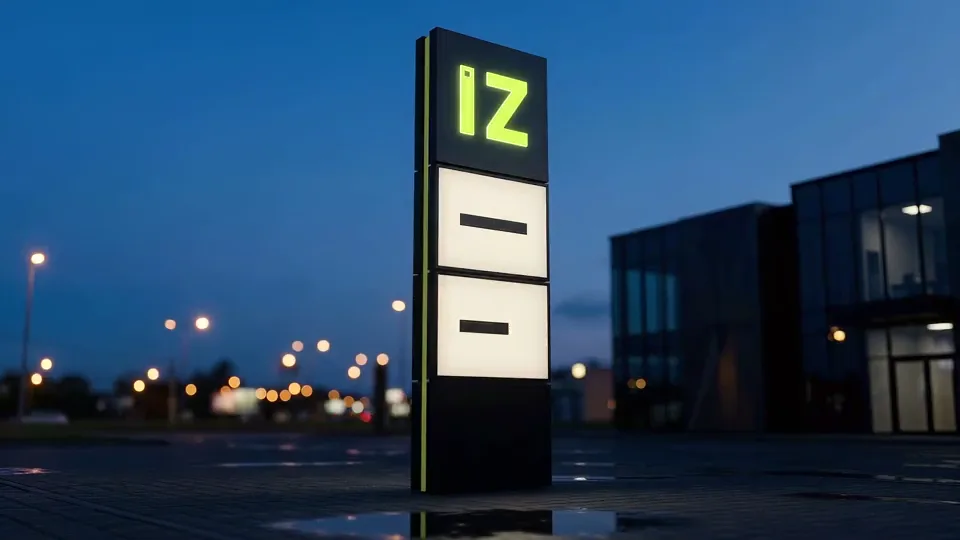
ADVERTISING & SIGNAGE · KEMALPASA / IZMIR
Pylon / Totem Signage
The tall, illuminated freestanding sign seen from far down the road. The station and mall standard.
·
A pylon (totem) sign is a tall, usually double-sided illuminated sign that stands at the roadside. It's one of the strongest outdoor markers, preferred by businesses that need to be seen from a distance. Fuel stations, malls, car dealers, and complex entrances.
We build pylon signs with a load-bearing steel structure, an illuminated box/acrylic face, and low-consumption LED. Height and orientation are planned to the distance and speed at which a vehicle will read the sign. Ground and structural safety are taken into account.
What’s included in Pylon / Totem Signage
- +Height and orientation plan based on reading distance
- +Load-bearing steel structure fabrication
- +Illuminated box / acrylic face with even LED lighting
- +Single or double-sided (two-way) option
- +Foundation, installation, and electrical connection
How Pylon / Totem Signage works
Survey & structure
We inspect the location and plan height, orientation, and foundation needs.
Design approval
We present the sign face and structure visual for your approval.
Production
The steel structure and illuminated face go into production. Production tracking stays with us.
Installation
We prepare the foundation, erect the sign, connect power, and hand over working.
Pylon / Totem Signage questions we are asked
Do I need a permit for a pylon sign?
Roadside and tall signs are usually subject to municipal, and in some locations, highway authority permits. Applying for and following up the permit is the business owner's responsibility. We run the production and installation of the approved sign.
Can it be double-sided?
Yes, a double-faced build lets vehicles from both directions see it. It's the most common choice.
Is a totem sign the same thing as a pylon sign?
Two names for the same product. The trade calls it a pylon sign, while totem is the more common word in everyday use. Either way it is a sign that rises from the ground on its own leg so it can be read from a distance. Fuel stations, industrial estate entrances and roadside businesses are where it is used most.
Which businesses use pylon signs?
Businesses set back from the road, or standing on a large plot. Auto service centres, car washes, haulage firms, factories and textile plants ask for them most often. A driver is not looking for the building, they are looking for the entrance, so the text has to be readable from the road. A facade sign is not enough in these cases, because the driver has already passed the turning before the building comes into view.
How tall should it be?
Height comes out of a calculation rather than taste. Three things decide it. How fast traffic passes, how many lanes the road has, and what stands in front of the sign. On a fast road the driver's reading time drops to about two seconds, so the lettering has to be larger and higher. In practice there are two bands. In town, in front of shops and at factory or estate entrances, 3 to 6 metres is the range, and 3 to 4 metres is chosen most often. Beside a motorway, at a mall or at a fuel station, where it has to be read from far away, it goes up to 8 to 15 metres. The second band needs heavy steel structure, wind-load and structural calculation, which makes it a project in its own right.
How is the foundation handled?
Half of a pylon sits below ground and is never seen. A tall sign carries wind load, so it needs a concrete foundation, and the size of that foundation follows the height of the sign. Whether the ground is soil or concrete, and whether services run beneath it, is checked during the survey. The most common surprise is an electrical or water line under the surface, so we ask before anything is dug. Once the foundation is poured, the concrete has to cure before the sign goes up. That wait is part of the job and cannot be skipped.
How are power and lighting handled?
The supply is run from the building's own board and the cable route is planned from the start. The cable usually passes through the foundation, because pulling it later means opening the ground again. For lighting we use LED, which draws noticeably less than the older fluorescent systems. A sensor or a timer can be added so the sign turns itself on and off. Most roadside businesses keep the sign lit through the night, since that is where it earns its keep, and for a business that switches off in the morning a sensor pays for itself quickly.
Does it need maintenance, and what happens if something fails?
Like anything electrical that lives outdoors, it asks for attention over time. The two most common items are an LED driver reaching the end of its life and the acrylic face getting dirty. Neither is a large job, though working at height needs equipment. One check a year is enough for most sites. If part of the sign has stopped lighting, it usually comes down to a single module rather than the whole board. We say this up front, because businesses often assume the entire sign has to be replaced.
Can several businesses share one pylon?
They can, and in office blocks and industrial estates it is the most requested arrangement. Built modularly, each business gets its own band, and when one moves out only that band changes. What has to be decided at the start is the number and size of the bands. A business that later wants an extra band runs into trouble if the supporting structure was not built for it, so during the survey we ask how many tenants there might eventually be and leave room for them.
Pricing here depends on dimensions, material and installation conditions, so we do not quote a single starting figure. The site survey is free. Web and digital plan pricing is written openly on the plans page.
Let's plan a survey and measurement to make your business visible from the road.