


DIGITAL · KEMALPASA / IZMIR
Custom QR Code Design
Not black-and-white squares. QR codes that carry your logo and colors, and still scan reliably.
·
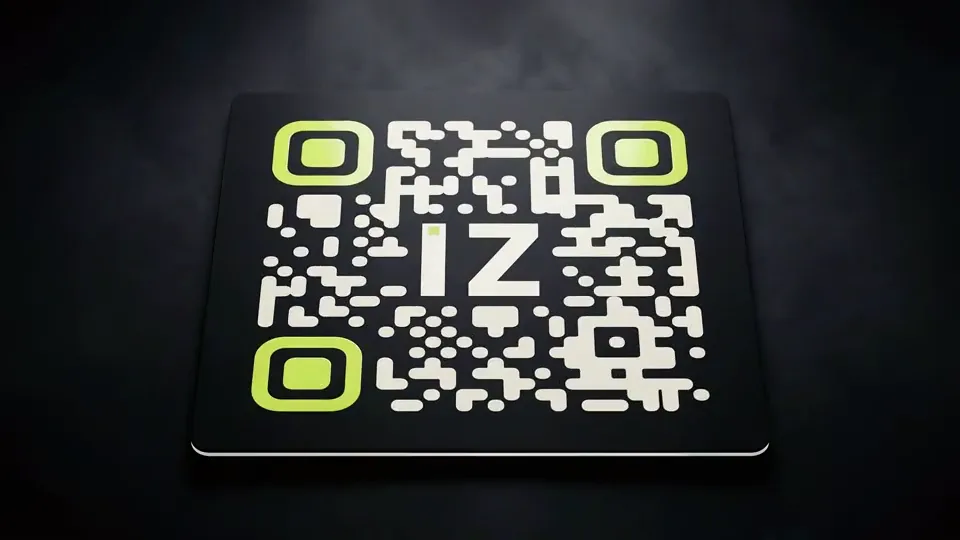
A standard QR code is a generic block of black-and-white squares. It has no connection to a brand and typically leaves no impression beyond "there's a QR code here." But a QR code's internal structure (its error-correction margin) allows room for logos, color, and shape within certain limits. Designed correctly, the brand comes through without costing the code a bit of its readability.
İZVELA designs custom QR codes to match your logo colors, shapes, and brand identity, and never skips the most critical step. Every custom QR code is tested for real-world scanning across different phones and lighting conditions before it is delivered. A QR code that looks impressive but does not scan is a useless QR code.
Here, too, examples speak louder than promises. You can browse sample QR codes designed for business cards, menus, packaging, and posters.
What’s included in Custom QR Code Design
- +Custom QR code design matching your logo and brand colors
- +Scannability testing across different devices and lighting conditions
- +Print-ready, high-resolution file delivery (in formats suited to business cards, menus, posters, and packaging)
- +Size and contrast recommendations tailored to the intended use
- +Integrated use with the QR menu or our other services on request
How Custom QR Code Design works
Intended use
We pin down exactly where the QR code will be used. Business card, menu, poster, packaging, and how.
Design
We prepare a QR code design that matches your logo and brand colors.
Scannability testing
We test it across different phones and lighting conditions, adjusting the contrast if needed.
Delivery
We deliver the print-ready file along with usage recommendations.
Custom QR Code Design questions we are asked
What is the difference between a custom-designed QR code and a regular one?
A regular QR code is just black-and-white squares with no visual connection to a brand. A custom-designed one integrates a logo, brand colors, and sometimes custom shapes into the code's structure. It carries the brand and, designed correctly, scans just as reliably. The difference is entirely visual. Technically, both run on the same standard.
Does a custom QR code actually scan, or is it harder to read than a standard one?
No, not when it is designed correctly. A QR code's structure has a built-in error-correction margin, and any logo or color added stays within that margin. Before delivery we test every custom QR code on different phone models and in different lighting. Problems usually come from contrast set too low or a logo covering too much of the code's readable area. We rule out both risks at the design stage.
What materials can a custom QR code be applied to?
It works on most digital and printed surfaces. Business cards, menus, product packaging, posters, storefront stickers, and more. The minimum size and contrast ratio change depending on the surface, which is why usage recommendations are always delivered alongside the file.
Can I get custom QR code design bundled with your other services?
Yes, pairing it with the QR menu or business card design is a common request, and it keeps your brand identity consistent across every touchpoint. When the website, business card, and QR code all come out of the same design language, the brand feels far more cohesive.
How much information can go inside the code?
Technically a great deal, but it should not. The more characters written into a code, the denser it becomes, meaning the squares shrink and reading gets harder. Embedding a long address directly into the code is why that goes badly. The answer is a short address. We open a short path on your own site and point the code at it. The code stays sparse and readable, and you can point that address at a different page later. The printed code stays the same while its destination changes.
What is error correction level?
A QR code carries spare data inside it so it can still be read if part of it is damaged. The proportion of that spare data can be chosen. As the level rises the code becomes more robust but also denser. The logo in the middle is possible precisely because of that margin, since the logo covers part of the code and the spare data compensates. We set the balance. Outdoors, on surfaces likely to be scratched or dirtied, we choose a high level. On protected surfaces such as a business card a lower level is enough and the code looks cleaner.
Can we change where the code points later?
If the code is printed straight to an address it cannot be changed, that code is fixed. This is why we put our own short address in between. The code looks at that address and the address forwards to whichever page you want. When a campaign ends, changing the destination is a single operation and every printed card, poster and package keeps working. That distinction is critical in printed work. A fixed code printed onto thousands of packages dies completely when the destination page closes.
Does the surface it will be printed on affect the design?
It does. On a glossy surface, reflected light makes it harder for the camera, so leaving a matt area or opening a matt-varnished patch helps. Printing a light code on a dark background is possible, but some older phones struggle with reversed contrast, so on critical uses we keep the classic orientation. On curved surfaces, bottles and tins for example, the code distorts and is designed slightly larger. On packaging work we also ask about the printing method, because some methods do not hold fine detail.
How do you test it before handover?
Testing on one phone is not enough, because camera software behaves differently. We try it on devices of different makes and ages. We change the lighting as well, daylight and dim conditions separately. There is a distance test too, reading the code from the real distance it will be used at. Where printed work is involved we take a small proof and test on that, because a code that reads on screen may not read in print. Skip that step and the problem only surfaces after thousands of copies.
Does a Google review card really increase the number of reviews?
It does, because the obstacle is not customer reluctance, it is effort. People are willing to leave a review when they are satisfied, but searching for the business on Google, finding the right listing and scrolling to the review field are three separate steps. The card reduces all of that to a single tap. Since review count and rating affect map ranking directly, this card is the smallest and cheapest part of the visibility work we sell.
How will the card sit on the table, do you make the stand?
We do. A card or a code on its own gets lost on a table, so we design the holder specifically for the business. Brand colour, logo and typeface stay the same as your menu and the sign on your facade. Cafe tables, in front of a salon mirror, a clinic reception desk and beside the till are the places used most. Once you tell us where it will stand we size it accordingly.
Website projects start from $250, and the monthly digital plans are listed separately. Full scope and pricing is written openly on the plans page.
If you want a QR code that carries your brand, browse the sample gallery and get in touch.